


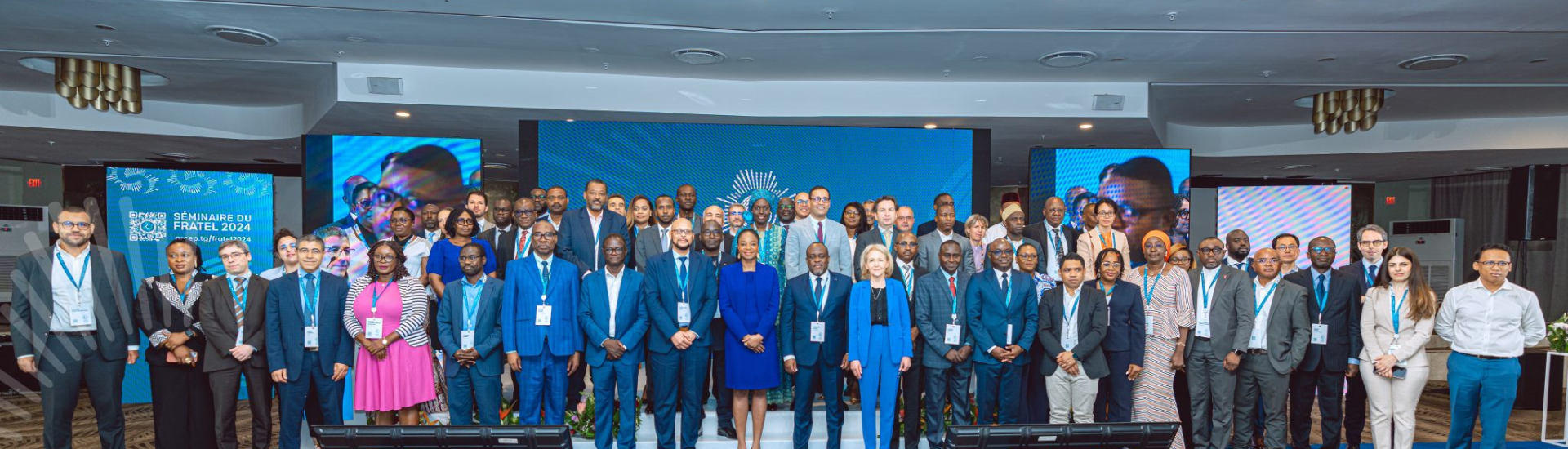
This year, the Francophone telecommunications regulators' network FRATEL is holding its 21st Annual Seminar 2024 in Lomé, Togo, under the theme: "Data Economy, Mobile Payments: What Techno-Economic Regulatory Challenges?" Due to their potential value, data (personal data, corporate data, social media data, health data, etc.) constitute a strategic asset, and their control presents growing challenges for states.
ARMD was invited to participate in discussions and roundtables under the auspices of Togo's Electronic Communications and Postal Regulatory Authority (ARCEP) and the Republic of Congo's Postal and Electronic Communications Regulatory Agency (ARPCE). Established in June 2002 in Paris, the FRATEL network aims to bring together and strengthen Francophone telecommunications regulators. The program for the 21st seminar spans May 21-22 and addresses several key issues, including:
“What challenges does the development of the data economy raise?” The rapid digitization of society leads to exponential data production, necessitating the creation of a secure environment conducive to data sharing and utilization. What technical and economic regulatory measures should regulators therefore implement?
“What public interventions can address potential market failures in data storage and processing?” Data overproduction has driven the growth of storage and cloud computing services, dominated by a few companies that telecommunications operators are compelled to use. This concentration in data storage services creates commercial and technical barriers while restricting competition. What initiatives can African countries implement to, on one hand, regain control over data collected in Africa and, on the other hand, better regulate these services locally?
“Sharing experiences on mobile payments” With the proliferation of mobile payments, it has become necessary to establish regulations that foster healthy competition among different service providers. How can regulatory authorities promote the emergence and development of fair competition?
These were the main issues discussed during the roundtables that brought together the principal directors-general of African telecommunications regulators, all members of the FRATEL network.

ARMD continues its operationalization efforts by participating in events such as the Fratel network seminar. The best practices from partner regulatory authorities, recommendations from experts present at the seminar, and conclusions drawn from the debates will enable ARMD to initiate national discussions on strategies for developing a controlled data economy and implementing regulatory and economic instruments suited to Djibouti's increasingly digital economy.
In recent years, Djibouti has seen the launch of mobile payment services D-Money and Waafi , whose usage continues to become more widespread among consumers. These electronic payment solutions facilitate and accelerate economic transactions, thereby directly contributing to consumption and economic growth. Establishing technical, economic, and regulatory frameworks governing the use of these mobile payment solutions will help secure and develop exchanges, protect the rights of all stakeholders (consumers and operators) regarding their respective data, and provide Djibouti with a reliable structure for data management.
Source: ARMD