



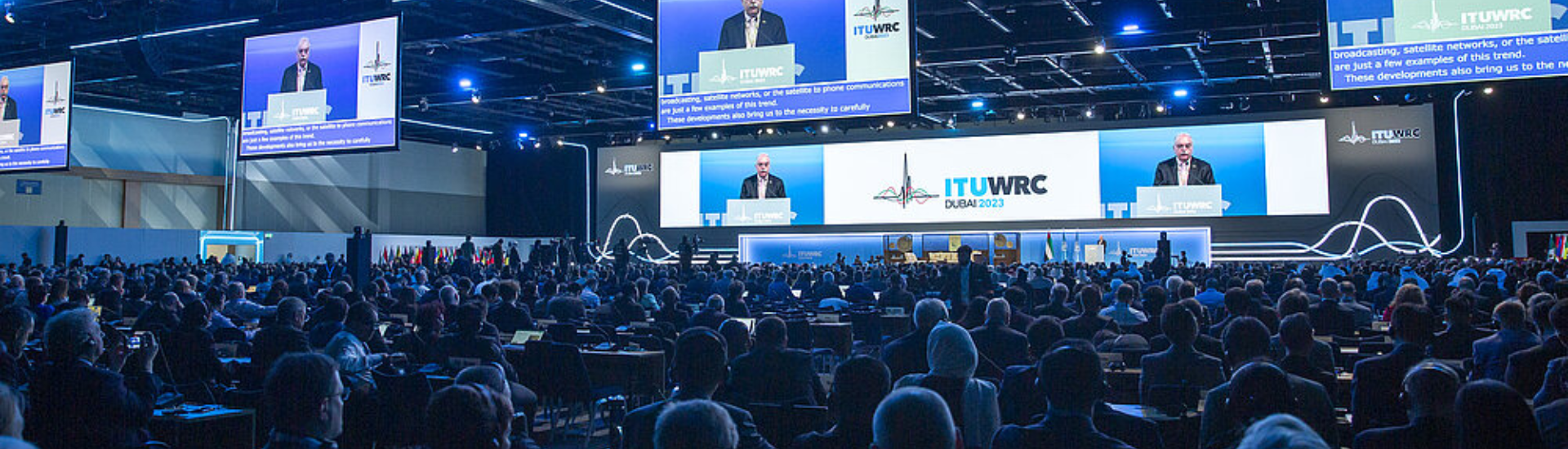
Under the patronage of His Highness Sheikh Ahmed bin Mohammed bin Rashid Al Maktoum, Second Vice President of Dubai, the WRC-23 (2023 edition of the World Radiocommunication Conference) was held in Dubai (United Arab Emirates) from November 20, 2023, to December 15, 2023. This quadrennial global event serves as the benchmark for radiocommunication matters. This year's edition brought together delegates from over 190 countries to debate and decide on the future of the radio frequency spectrum, directly influencing technological development, the digital economy, and global connectivity.
A Djiboutian delegation composed of representatives from the Multisectoral Regulatory Authority of Djibouti and the Ministry of Communication in charge of Posts and Telecommunications participated in this event, highlighting the policy for the development of Information and Communication Technologies (ICT) in Djibouti and the progress made in this sector. During this conference, the Djiboutian delegation met with various attending dignitaries to showcase Djibouti's ICT policy, which aims to accelerate the country's digital transformation. Several discussions were also initiated with international partners to promote the achievement of Djibouti's strategic objectives in the management of the radio frequency spectrum.

Approximately 4,000 representatives participated in the discussions to update the Radio Regulations, which establish the conditions governing access to the radio frequency spectrum. This document holds the status of an international treaty. Nearly 3,000 submissions were made, addressing themes such as improving satellite connectivity, better harmonization of space applications, and the coexistence of satellite applications with various radiocommunication services.
The International Telecommunication Union organizes conferences every 3 to 4 years (called World Radiocommunication Conferences or WRCs), bringing together member states to facilitate negotiations on the proper management and allocation of the radio frequency spectrum. The very first International Radiotelegraph Conference (now known as the Radio Regulations or RR) was held in Berlin in 1906, giving rise to an international treaty aimed at establishing equitable access to the radio frequency spectrum and regulating the orbits of geostationary and non-geostationary satellites. At the conclusion of a WRC, various decisions can be made. The ITU may propose revisions to the Radio Regulations and associated frequency allocation plans, discuss radiocommunication matters at the global level, analyze the activities of the Radio Regulations Board and the Radiocommunication Bureau, provide them with recommendations, and prepare the topics for the agenda of the next WRC.

After a marathon of conferences and debates, WRC-23 led to the adoption of several major decisions. The expansion of the spectrum for mobile telecommunication services will allow for the allocation of new frequency bands for the deployment of 5G to meet the growing demand for mobile broadband services. WRC-23 also strengthened the global harmonization of frequency bands to reduce equipment costs and accelerate the rapid dissemination of new technologies. With the aim of reducing the digital divide in developing countries, WRC-23 included the needs of these countries in decision-making and facilitated their access to the spectrum and new technologies. WRC-23 also emphasized innovation by supporting new technologies such as the Internet of Things (IoT), machine-to-machine communications (M2M), and smart applications. Frequency bands have been identified for these emerging uses. The conference considered environmental issues, adopting resolutions to minimize the impact of radiocommunications on the environment and promote sustainable practices.
The next WRC (WRC-27) will be held in 2027 in Geneva, Switzerland, the city hosting the headquarters of the International Telecommunication Union, and the issues to be addressed are already under preparation.
Source: ARMD